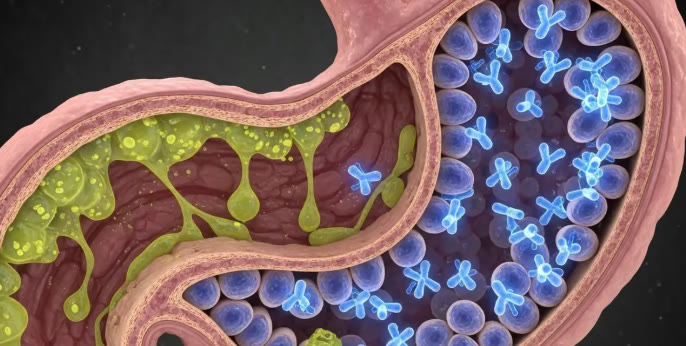
If you have one autoimmune disease, you're more likely to have another — and with Hashimoto's, one of the most common companions sits in a place no one associates with the thyroid: the stomach. Autoimmune gastritis blocks the absorption of vitamin B12, produces symptoms almost identical to those of hypothyroidism and, on top of that, interferes with the absorption of levothyroxine itself. This association has been known for decades and is still underdiagnosed today. In this article, every claim comes with the scientific reference behind it — the full list is at the end.
Why autoimmune diseases travel in groups
An immune system that misses its target once tends to miss again, in another organ. This tendency is so well recognized that it has a name: autoimmune polyglandular syndromes, described and classified in the medical literature (Betterle and Zanchetta, Acta Biomedica, 2003).
Hashimoto's thyroiditis is the most common piece of these clusters. And one of its classic companions is precisely autoimmune gastritis.
This is not an academic curiosity. One study specifically evaluated patients with autoimmune thyroid disease, looking for atrophic gastritis of the body of the stomach, and concluded that the association is underdiagnosed — in other words, it's there more often than anyone looks for it (Centanni et al., Archives of Internal Medicine, 1999).
Having Hashimoto's doesn't mean you will have autoimmune gastritis. It means it's more likely in you than in the general population.
What autoimmune gastritis does
To absorb vitamin B12 from food, the body needs a substance produced by specific cells in the stomach. Without it, the vitamin passes through the intestine and is lost — no matter how good the diet is.
In autoimmune gastritis, the immune system attacks precisely these cells. The result is a progressive B12 deficiency, which in its more advanced stage is known as pernicious anemia (Lahner and Annibale, World Journal of Gastroenterology, 2009).
The point that matters most for readers of this blog: the deficiency sets in slowly, over years. There's no single day when the person feels sick and finds out. There are months of nonspecific symptoms, each one easily blamed on something else.
The symptoms that get mistaken for the thyroid
Here is the reason this article exists.
Fatigue. Trouble concentrating and that feeling of a slow brain. Poor memory. Low mood. Pallor.
Compare this with the articles on this blog about brain fog and about ferritin: it's the same list. That's why B12 deficiency is so easily mistaken for poorly controlled hypothyroidism — and so easily blamed on the thyroid when the person already has the diagnosis.
But there is a group of symptoms that belongs to B12 and not to hypothyroidism, and it's worth knowing them:
- Tingling in the hands and feet, or a feeling of numbness
- Electric-shock or pins-and-needles sensations
- Unsteadiness when walking, especially in the dark
- A burning tongue, or a smooth, reddened tongue
Persistent tingling is not a classic symptom of hypothyroidism. When it shows up, B12 needs to be part of the conversation.
Why speed matters here
This is the most serious part of the article.
The anemia of B12 deficiency is corrected with replacement. The neurological damage, not necessarily. When the deficiency drags on, the changes in sensation and balance may not fully reverse even after treatment (Langan and Goodbred, American Family Physician, 2017).
It's the opposite of what happens with most thyroid problems, where lost time can be made up. Here, some of the lost time doesn't come back.
That's why tingling deserves investigation now, not at your next routine appointment.
The practical link to levothyroxine
There's a second, very concrete reason for thyroid patients to pay attention to the stomach.
Levothyroxine needs stomach acid to be absorbed well. When the stomach produces less acid — as happens in autoimmune gastritis — less hormone reaches the bloodstream.
This has been demonstrated: patients with gastritis and H. pylori infection needed higher doses of thyroxine to reach the same level of control (Centanni et al., New England Journal of Medicine, 2006). And, specifically in people with autoimmune hypothyroidism, the presence of the antibody that marks autoimmune gastritis was associated with a higher levothyroxine requirement (Checchi et al., Journal of Clinical Endocrinology & Metabolism, 2008).
If your levothyroxine dose keeps going up for no clear reason, the stomach is a place worth looking.
The honest counterweight: this isn't a test for everyone
I need to pull the brake here, because the easy takeaway from this article would be "everyone with Hashimoto's needs to have their stomach investigated." They don't.
Most people with Hashimoto's don't have autoimmune gastritis and won't develop it. Checking B12 routinely, every year, in someone with no symptoms and no risk factors, is a test without a question — and a test without a question produces borderline findings, which lead to repeat testing, which leads to anxiety.
What does justify investigating:
- Neurological symptoms, especially tingling
- Fatigue and brain fog that don't improve once the thyroid is already under control
- Anemia, especially with large red blood cells on the complete blood count
- A rising need for levothyroxine with no apparent cause
- Another autoimmune disease in you or your family
- Long-term use of metformin, which is associated with B12 deficiency (Aroda et al., Journal of Clinical Endocrinology & Metabolism, 2016)
- Ongoing use of heartburn medication, which reduces stomach acidity
- A diet with no animal foods, which is another cause, due to lack of intake
There's also a technical caveat that prevents hasty conclusions: the B12 test has limitations. A value in the low-normal range may not rule out deficiency, and in those cases there are other markers that help decide (Carmel, American Journal of Clinical Nutrition, 2011). A borderline result with suggestive symptoms deserves further investigation, not a clean bill of health.
And one point that calls for care in how it's said: pernicious anemia is a condition that requires long-term follow-up, because it's associated with an increased risk of gastric problems over the years (Vannella et al., Alimentary Pharmacology & Therapeutics, 2013). This is no reason to panic — it's a reason not to treat it and forget about it. Anyone with the diagnosis deserves an agreed-upon follow-up plan, and anyone without it doesn't need to worry about this.
The practical mistake that ruins everything
If you take away just one thing from this article, let it be this:
Don't blame tingling on your thyroid.
It's the mix-up that costs the most, because it's precisely the symptom where time matters. Fatigue mistakenly blamed on the thyroid costs months of discomfort. Tingling mistakenly blamed on the thyroid can cost sensation that doesn't come back.
What to bring to your appointment
- Describe the tingling precisely: where, since when, whether it's constant, whether it gets worse in any situation.
- Mention any change in your balance, especially when walking in the dark or with your eyes closed in the shower.
- Bring your complete blood count, and ask them to look at the size of your red blood cells — not just whether you're anemic.
- Report any use of metformin or heartburn medication, and for how long.
- Say whether your levothyroxine dose has been going up over the years with no clear explanation.
- Ask for a B12 test given this set of findings — and ask what to do if it comes back borderline.
The takeaway
Autoimmune gastritis is a frequent companion of Hashimoto's, interferes with the absorption of both B12 and levothyroxine at the same time, and produces symptoms that overlap almost completely with those of a poorly controlled thyroid.
It's not a matter of testing everyone. It's a matter of knowing it exists — and of recognizing the set of signs that calls for looking for it.
When fatigue comes with tingling, the conversation is no longer just about the thyroid.
Scientific references
- Betterle C, Zanchetta R. Update on autoimmune polyendocrine syndromes (APS). Acta Biomedica. 2003;74(1):9-33. PMID: 12817789.
- Centanni M, Marignani M, Gargano L, et al. Atrophic body gastritis in patients with autoimmune thyroid disease: an underdiagnosed association. Archives of Internal Medicine. 1999;159(15):1726-1730. PMID: 10448775.
- Lahner E, Annibale B. Pernicious anemia: new insights from a gastroenterological point of view. World Journal of Gastroenterology. 2009;15(41):5121-5128. PMID: 19891010.
- Langan RC, Goodbred AJ. Vitamin B12 deficiency: recognition and management. American Family Physician. 2017;96(6):384-389. PMID: 28925645.
- Centanni M, Gargano L, Canettieri G, et al. Thyroxine in goiter, Helicobacter pylori infection, and chronic gastritis. New England Journal of Medicine. 2006;354(17):1787-1795. PMID: 16641395.
- Checchi S, Montanaro A, Pasqui L, et al. L-thyroxine requirement in patients with autoimmune hypothyroidism and parietal cell antibodies. Journal of Clinical Endocrinology & Metabolism. 2008;93(2):465-469. PMID: 18042648.
- Carmel R. Biomarkers of cobalamin (vitamin B-12) status in the epidemiologic setting. American Journal of Clinical Nutrition. 2011;94(1):348S-358S. PMID: 21593511.
- Vannella L, Lahner E, Osborn J, Annibale B. Systematic review: gastric cancer incidence in pernicious anaemia. Alimentary Pharmacology & Therapeutics. 2013;37(4):375-382. PMID: 23216458.
- Aroda VR, Edelstein SL, Goldberg RB, et al. Long-term metformin use and vitamin B12 deficiency in the Diabetes Prevention Program Outcomes Study. Journal of Clinical Endocrinology & Metabolism. 2016;101(4):1754-1761. PMID: 26900641.
📖 Want to go deeper? My book HASHIMOTO'S covers the protocols and foundations of the functional approach to hypothyroidism and Hashimoto's: available on Amazon.
📅 Personalized consultation (in person in Campinas, São Paulo, Brazil, or via teleconsultation): WhatsApp +55 11 99385-1224
📱 Follow on Instagram: @drandre.azevedo