You do everything right. You take your levothyroxine every day, you avoid gluten, you see your doctor regularly. But your antibodies stay high. The fatigue won't go away. You still feel unwell — and your doctor tells you your labs are "normal."
So what's going wrong? The answer may lie in the most unexpected place: your gut.
What science has recently discovered
In recent years, medical science has gathered evidence that completely changes how we understand Hashimoto's. A review published in 2025 in Frontiers in Microbiology (PMC12521424) and another in Frontiers in Cellular and Infection Microbiology (2024) showed something that conventional medicine still overlooks in everyday clinical practice: people with Hashimoto's have a profoundly altered gut microbiome — and that imbalance fuels autoimmunity.
This isn't a theory. It's peer-reviewed science, published in leading journals around the world. Studies show that these patients have:
- Fewer protective bacteria, such as Lactobacillus and Bifidobacterium
- More inflammatory bacteria that stimulate the immune system
- Elevated zonulin — the protein that signals a compromised intestinal barrier
- Increased intestinal permeability — the well-known "leaky gut"
When the intestinal barrier loses its integrity, food and bacterial antigens cross into the bloodstream. In genetically susceptible people, this triggers and sustains the autoimmune response against the thyroid. In other words: an inflamed gut may be the fuel that keeps Hashimoto's active.
What you're feeling has a scientific name
If this sounds familiar — anti-TPO and anti-thyroglobulin antibodies that won't come down despite treatment, persistent symptoms even with a "normalized" TSH, frequent digestive issues (bloating, gas, irregular bowel habits), food sensitivities (especially to gluten and dairy), fatigue that sleep doesn't fix — know that you are not exaggerating. Your body is sending signals that a conventional approach was never trained to interpret.
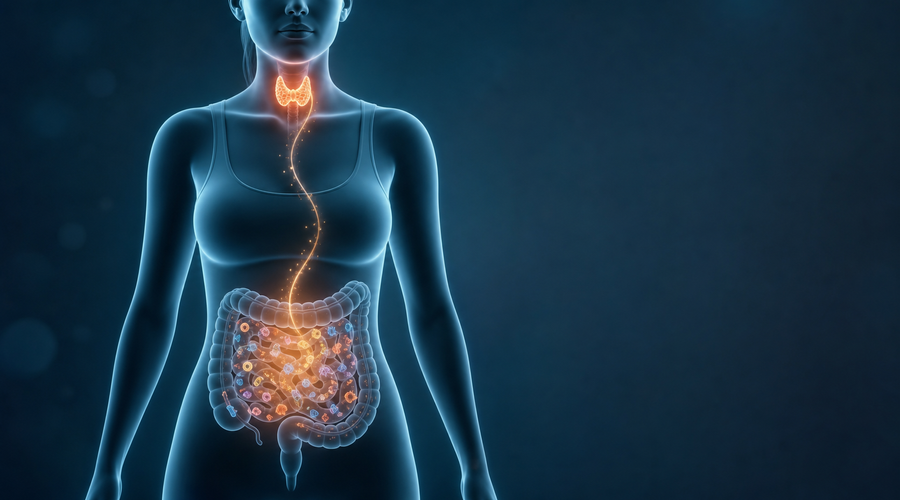
The gut-thyroid axis is a two-way street: the thyroid affects the gut, and the gut affects the thyroid. Neither works well when the other is compromised.
What to do in practice
The good news is that the gut microbiome can be changed. Science points to concrete steps:
- Investigate intestinal permeability. Measuring serum zonulin, together with a targeted clinical evaluation, can show whether leaky gut is active and fueling autoimmunity.
- Rebalance the microbiome with precision. This doesn't mean grabbing any probiotic off the pharmacy shelf. It means choosing specific strains with evidence in autoimmune disease, at the right dose and for the right length of time — something that requires an individualized medical evaluation.
- Remove inflammatory triggers. Gluten, dairy, refined sugar, and ultra-processed foods increase intestinal permeability. A targeted elimination diet, when properly indicated, can significantly lower antibodies.
- Targeted nutritional support. Zinc, glutamine, vitamin D, and short-chain fatty acids have evidence for restoring the integrity of the intestinal barrier.
- Treat stress as a biological factor. The gut-brain axis is real. Chronically elevated cortisol damages the microbiome and increases intestinal permeability. Managing stress isn't a luxury — it's part of the treatment.
Conventional treatment and the functional integrative approach
Conventional medicine treats Hashimoto's by replacing the hormone the thyroid can no longer make. That's necessary — but it isn't enough. A functional integrative approach broadens the investigation: it asks why the immune system is attacking the thyroid, what may be keeping that attack going, and which factors need to be considered in individualized care. The gut is one of the most important pillars of that investigation.
In my 25 years of clinical practice with Hashimoto's patients, I have seen again and again how treating the gut changes the course of the disease. Antibodies that hadn't budged in years start to come down. Symptoms that seemed permanent begin to ease. Not because it's a miracle — because it's science, applied completely.
Scientific references
👉 Book your appointment and find out what's keeping your Hashimoto's going: WhatsApp +55 11 99385-1224
📖 In my book HASHIMOTO'S, I walk through the gut-thyroid axis, lab tests, and science-based care strategies: learn about the book