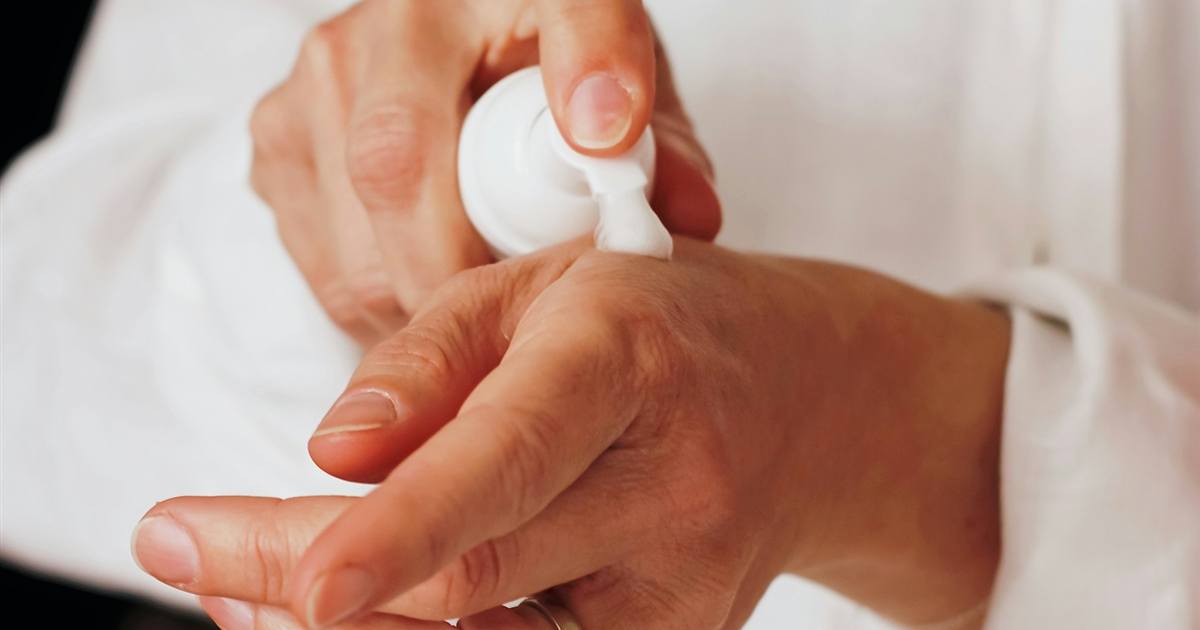
The skin is one of the first places a lack of thyroid hormone shows up — and one of the last places anyone thinks to look. Rough skin that lotion won't fix, nails that peel and won't grow, eyebrows thinning at the outer edge: on its own, each of these complaints means nothing, but together they form a pattern a trained doctor can spot from across the room. After 25 years of caring for thyroid patients, I've learned that these signs often show up months before the diagnosis. In this article, every claim comes with the scientific reference that supports it — the full list is at the end.
Why the skin dries out
Thyroid hormone acts on the skin directly, not as a side effect of something else.
It plays a role in renewing the cells of the outermost layer, in maintaining the barrier that keeps water inside the body, and in the function of the glands that produce sweat and oil (Safer, Current Opinion in Endocrinology, Diabetes and Obesity, 2012).
When this hormone is lacking, three things happen at once: the skin renews itself more slowly, produces less sweat and less oil, and loses more water to the environment. The result is skin that is rough and dull, flakes finely, and doesn't improve for long with cream.
This is one of the most common skin manifestations of hypothyroidism, described in dermatology for decades (Heymann, Journal of the American Academy of Dermatology, 1992; Doshi et al., Clinics in Dermatology, 2008).
It's not neglected skin. It's skin that stopped getting the signal to renew itself at the right pace.
The puffiness that isn't fluid retention
This is the most characteristic sign — and the most misread.
In hypothyroidism, a type of substance that attracts and holds water builds up in the skin, producing a swelling with a peculiar texture. It's most visible on the face and eyelids, giving the face a "dull" or thickened look.
The technical name for this is myxedema, and it has one feature that sets it apart from ordinary fluid retention: it doesn't leave a dent when you press it with your finger. Swelling from fluid retention pits and is slow to bounce back; this kind doesn't.
That's why diuretics don't help, and why so many people spend years being told they're "retaining fluid" when the problem is something else.
If your facial puffiness doesn't improve with anything and doesn't leave a dent when you press it, it's worth a conversation about your thyroid.
Nails, hair, and eyebrows
Nails follow the same logic as skin: they grow more slowly and become thin, brittle, and ridged, and they tend to peel in layers.
It helps to know that brittle nails have many possible causes, and systemic diseases — thyroid disease among them — are on the list that should be considered before treating the problem only from the outside (van de Kerkhof et al., Journal of the American Academy of Dermatology, 2005).
When it comes to hair, this blog already has a dedicated article on the subject, and it's worth reading. But there's one detail that almost never comes up and is quite specific: thinning of the outer third of the eyebrow — the part that extends toward the temple. It's a classic sign described in the dermatology literature on thyroid disease, and many people notice it in the mirror without knowing it means anything.
It's also worth noting that autoimmune thyroid disease is accompanied by other skin conditions more often than chance would explain — vitiligo and alopecia areata among them (Ai et al., Journal of the American Academy of Dermatology, 2003).
The honest counterpoint: dry skin is nonspecific
Here I need to tap the brakes, because this is a topic where it's very easy to frighten people for no reason.
The vast majority of people with dry skin have no thyroid problem whatsoever.
Dry skin is common in winter, in air-conditioned rooms, with long, very hot showers, with harsh soaps, with age, and with skin conditions that have nothing to do with hormones. The same goes for weak nails.
Two things change how much weight the sign carries:
First, change. What matters isn't having dry skin your whole life — it's skin that was always normal and then changed. A new change deserves attention; a long-standing trait, much less so.
Second, the whole picture. Dry skin on its own tells you almost nothing. Dry skin plus fatigue, constipation, weight gain without any change in diet, feeling cold at odd times, hair loss, and that facial puffiness starts to form a picture.
And there are causes that closely mimic this picture and need to be considered: low iron, associated with hair loss and fragile nails (Trost et al., Journal of the American Academy of Dermatology, 2006); zinc, whose deficiency causes well-described skin changes (Ogawa et al., Nutrients, 2018); and vitamin B12 (Langan and Goodbred, American Family Physician, 2017).
Why moisturizer isn't the problem — or the solution
There's nothing wrong with moisturizing. A good moisturizer makes you more comfortable, reduces roughness, and is worth using.
What it doesn't do is change the cause. If your skin is drying out because you're short on hormone, the cream treats the surface while the underlying cause keeps working beneath it — along with all the other effects of hypothyroidism that don't show up in the mirror.
Moisturizer takes care of today's symptom. It doesn't replace the question of why your skin changed.
How long it takes to improve
This is the part that prevents frustration — and almost no one mentions it.
Skin and nails do respond to treatment, but slowly — because their biology is slow.
- Skin usually takes anywhere from a few weeks to a few months to look different after your labs normalize.
- Facial puffiness usually goes down noticeably, but also over the course of weeks.
- Nails are the slowest of all: a fingernail takes about six months to grow out completely, and a toenail takes much longer. In other words, the nail you see today was formed months ago. Judging treatment by your nails after four weeks makes no sense — they're still showing you the past.
People who expect results in two weeks conclude it didn't work and abandon a treatment that was right.
The practical mistake that ruins everything
If you take away just one thing from this article, let it be this:
Don't spend months on cosmetic treatments for a symptom that may be hormonal.
It's a sequence I see often: someone invests in expensive creams, facial skin procedures, nail strengtheners, beauty supplements — all from the outside, for a year — while their hypothyroidism goes undiagnosed. And along with it go the fatigue, the cholesterol, the mood, and everything else.
What to do
- Look at the whole picture, not a single item. Write down what else changed along with your skin.
- Note when it started. Was it gradual? Did it coincide with anything else?
- Check your eyebrows in the mirror, specifically the outer tips.
- Test the puffiness: press the skin of your face or eyelid with your finger and see whether it leaves a dent.
- Ask for a TSH test if the whole picture is there — it's inexpensive and answers the question.
- Keep moisturizing in the meantime. One doesn't rule out the other.
The bottom line
Your skin and nails work like an outside gauge of something happening on the inside. They can't make a diagnosis on their own — dry skin is far too common for that — but when they change along with other signs, they point in a direction that takes just a blood test to confirm.
The sign that counts isn't having dry skin. It's skin that has changed, along with other things that changed at the same time.
If you recognized yourself here — skin that didn't used to be like this, nails that won't grow, eyebrows thinning at the tips, and facial puffiness no one can explain — bring all of it to your appointment as one picture, not as a beauty complaint. That's how this picture becomes a diagnosis.
Scientific references
- Safer JD. Thyroid hormone action on skin. Current Opinion in Endocrinology, Diabetes and Obesity. 2012;19(5):388-393. PMID: 22914563.
- Heymann WR. Cutaneous manifestations of thyroid disease. Journal of the American Academy of Dermatology. 1992;26(6):885-902. PMID: 1607406.
- Doshi DN, Blyumin ML, Kimball AB. Cutaneous manifestations of thyroid disease. Clinics in Dermatology. 2008;26(3):283-287. PMID: 18640525.
- Ai J, Leonhardt JM, Heymann WR. Autoimmune thyroid diseases: etiology, pathogenesis, and dermatologic manifestations. Journal of the American Academy of Dermatology. 2003;48(5):641-659. PMID: 12734493.
- van de Kerkhof PC, Pasch MC, Scher RK, et al. Brittle nail syndrome: a pathogenesis-based approach with a proposed grading system. Journal of the American Academy of Dermatology. 2005;53(4):644-651. PMID: 16198786.
- Trost LB, Bergfeld WF, Calogeras E. The diagnosis and treatment of iron deficiency and its potential relationship to hair loss. Journal of the American Academy of Dermatology. 2006;54(5):824-844. PMID: 16635664.
- Ogawa Y, Kinoshita M, Shimada S, Kawamura T. Zinc and skin disorders. Nutrients. 2018;10(2):199. PMID: 29439479.
- Langan RC, Goodbred AJ. Vitamin B12 deficiency: recognition and management. American Family Physician. 2017;96(6):384-389. PMID: 28925645.
📖 Want to go deeper? My book HASHIMOTO'S covers the protocols and foundations of the functional approach to hypothyroidism and Hashimoto's: available on Amazon.
📅 One-on-one appointments, in person in Campinas, São Paulo (Brazil) or by teleconsultation: WhatsApp +55 11 99385-1224
📱 Follow me on Instagram: @drandre.azevedo