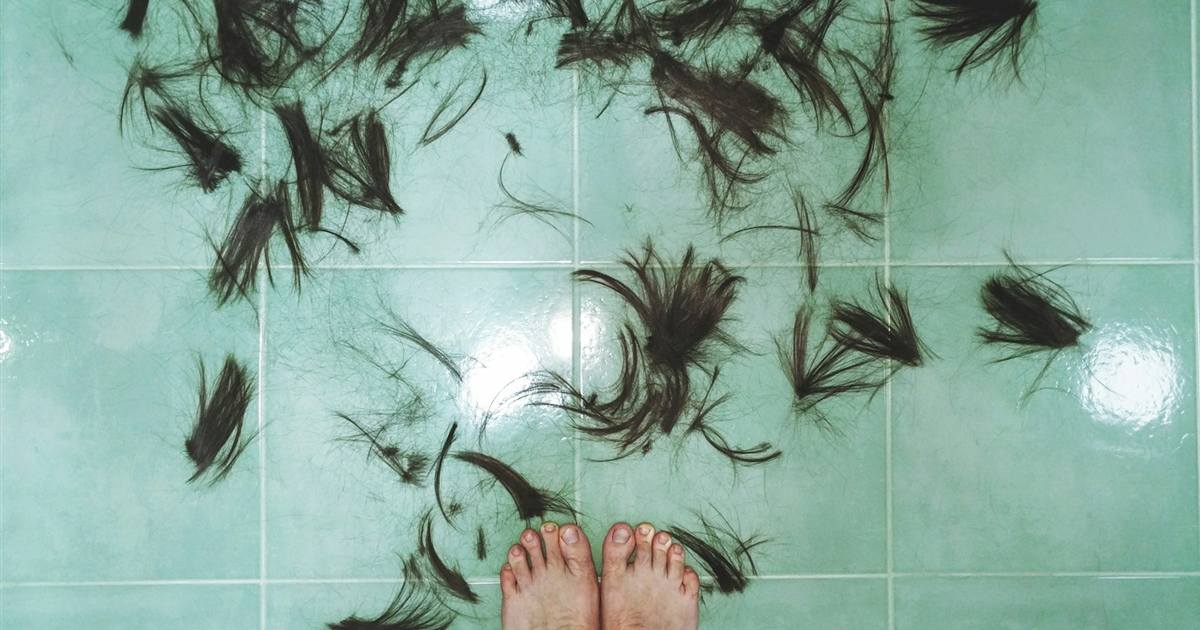
She brought a photo on her phone — the shower drain, clogged with hair, taken that morning in Campinas before she came in for her appointment. "This isn't normal, is it?" She had already seen a dermatologist and tried all sorts of shampoos and hair serums, and her hair was still falling out in noticeably larger amounts than usual. Her routine labs, done months earlier, had come back "within range." Until then, no one had asked about her thyroid.
Hair loss is one of the most common — and most frustrating — complaints I hear in the office, because it rarely has a single, obvious cause. But it is also very often underestimated as a sign of thyroid dysfunction, especially when TSH looks "normal" on a first test.
Hair loss isn't always some vague "hormonal thing"
Women with hair loss often hear that it's "just hormones" — a vague explanation that rarely leads to any real investigation. In practice, there are well-defined causes that can be looked into: iron deficiency (assessed by ferritin, not just hemoglobin), vitamin D deficiency, intense physical or emotional stress, the postpartum period, recent restrictive diets, and thyroid dysfunction — including hypothyroidism and Hashimoto's thyroiditis.
The problem is that, in the rush of a standard appointment, the thyroid tends to be the last possibility considered rather than the first — even though it is one of the most treatable causes once correctly identified. That delays the diagnosis and stretches out months (sometimes years) of trial and error with topical products that don't address the underlying cause.
How thyroid hormone acts directly on the hair follicle
Contrary to what many people think, the link between the thyroid and hair isn't just indirect or "general metabolism" — thyroid hormone acts directly on the hair follicle. A study published in the Journal of Clinical Endocrinology & Metabolism by van Beek and colleagues showed, in cultured human hair follicles, that thyroid hormones (T3 and T4) prolong the anagen phase — the active growth phase of the hair — and stimulate the proliferation of hair matrix cells, the cells that actually produce the hair shaft.
In practical terms, this means that when less active thyroid hormone is available to the tissues — even slightly less — the hair cycle can be cut short: more hairs move prematurely into the shedding (telogen) phase, and fewer stay in the growth phase. The result, weeks or months later, is diffuse shedding with no localized "bald spot" — unlike, for example, androgenetic alopecia.
Telogen effluvium: why hair loss shows up months after the real trigger
One of the most misunderstood aspects of hair loss is the lag between the trigger (thyroid dysfunction, an episode of acute stress, rapid weight loss) and the moment the shedding actually becomes visible. The hair cycle has phases that last months; when a trigger pushes hairs out of the growth phase and into the shedding phase, the visible effect — the familiar "hair coming out in clumps" — only appears two to four months later.
That explains why so many patients can't link their hair loss to any recent event: the real trigger was "hidden" a few months in the past. A thyroid change that had been quietly developing — often with TSH still within the reference range, as we discussed in the previous article in this series — may be exactly that invisible trigger.
Hair loss even with a "normal" TSH: what else is worth investigating
Just as there can be symptoms of hypothyroidism with TSH within the reference range, hair loss can appear in that same scenario. So when hair loss persists with no obvious cause, it makes clinical sense to go beyond TSH alone and look at the full picture: free T3, thyroid antibodies (anti-TPO), ferritin (not just a complete blood count), vitamin D, and the history of recent events — childbirth, restrictive diets, surgery, rapid weight loss or intense emotional stress.
None of these tests settles the diagnosis on its own. But together they help distinguish hair loss that is mainly nutritional from hair loss linked to a thyroid process still in its early stages, which deserves monitoring and, eventually, specific treatment.
Hair loss rarely has a single cause — and a single topical product rarely solves what is, at its root, a whole-body problem.
How functional clinical reasoning approaches hair loss
Functional Integrative Health doesn't treat hair loss as an isolated scalp problem, but as a symptom that reflects what is happening in the rest of the body. That means putting together the complete clinical history — how long it has been going on, the shedding pattern, the events that came before the first signs — with a lab panel broader than TSH alone, and a focused physical exam.
The goal of this reasoning isn't to prescribe a specific product or supplement to "stop" the shedding, but to understand which underlying process is shortening the time hairs stay in the growth phase — and to treat that process, once identified, with proper clinical follow-up.
When it's worth digging deeper
Some signs make a more thorough investigation especially worthwhile: diffuse (not localized) shedding that lasts more than three months, weak or brittle nails at the same time, fatigue or cold intolerance alongside it, a family history of thyroid or autoimmune disease, and hair loss that got worse after childbirth, a restrictive diet or rapid weight loss.
In these cases, the most efficient path isn't trying product after product, but seeking an evaluation that brings together clinical history, physical exam and targeted lab tests — one that can tell whether there really is a thyroid component behind the hair loss.
Individualizing care is the key point
There is no single test, and no single supplement, that solves hair loss for everyone. What exists is a set of possible causes, often overlapping, that need to be investigated and prioritized individually — taking into account each patient's history, test results and circumstances.
In the next article in this series, we'll explore another connection that rarely gets discussed: the link between the thyroid (especially Hashimoto's thyroiditis) and anxiety symptoms, and why so many patients end up treated only for their mental health without anyone checking their thyroid.
Scientific evidence
📖 Want to go deeper? My book covers the protocols and foundations of the functional approach to hypothyroidism and Hashimoto's: HASHIMOTO'S, available on Amazon.
📅 Individualized appointments (in person in Campinas, São Paulo, Brazil, or via teleconsultation): WhatsApp +55 11 99385-1224
📱 Follow on Instagram: @drandre.azevedo