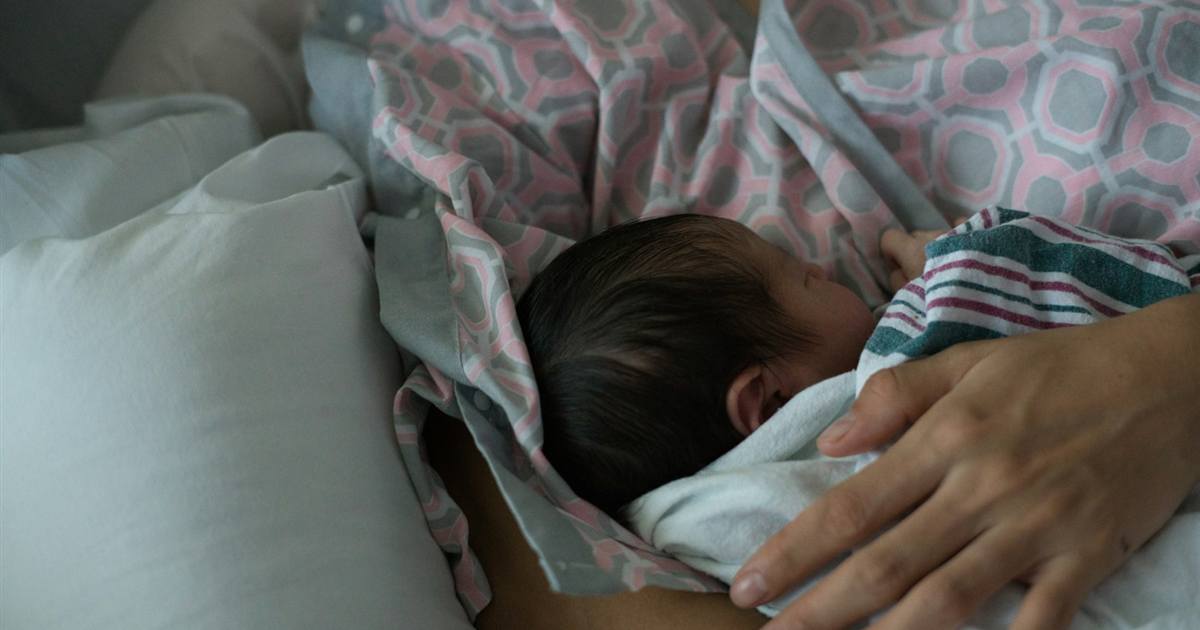
In the first year after giving birth, about one in every twelve women develops a thyroid disorder — and almost none of them are told it even exists. It's called postpartum thyroiditis, and the problem isn't that it's rare: it's that its symptoms are exactly the ones everyone blames on the exhaustion of having a newborn. A racing heart, irritability, and insomnia first; then exhaustion, sadness, and sluggishness. These complaints usually get a different name before anyone thinks of ordering a blood test. In this article, every statement comes with the scientific reference that supports it — the full list is at the end.
How many women this affects
This isn't a once-in-a-blue-moon diagnosis.
A review that pooled the available studies on the subject found postpartum thyroid dysfunction in around 8% of women (Nicholson et al., Thyroid, 2006).
To put that in perspective: in a waiting room with twelve women who had a baby in the past year, you'd expect one of them to be going through this. Even so, it's rare for anyone to leave the maternity ward having heard of it.
It isn't rare. It's rarely looked for — which is a very different thing.
The two phases, and why each one is misleading
This is the part that explains the confusion, because the condition changes its face over the months.
What happens is an inflammation of the gland that makes the thyroid release all at once the hormone it had stored, and then run temporarily out of supply. Hence the two-stage course (Stagnaro-Green, Journal of Clinical Endocrinology & Metabolism, 2012):
The first, sped-up phase usually appears in the first few months. A pounding heart, feeling hot, irritability, anxiety, insomnia, weight loss, shaky hands.
The second, slowed-down phase usually comes afterward. Unusual fatigue, low energy and motivation, sadness, trouble concentrating, constipation, dry skin, aches.
And here's the problem: each of these phases has a ready-made diagnosis waiting for it. The first becomes "postpartum anxiety." The second becomes "postpartum depression" or simply "that's normal, you just had a baby."
It's important to know that not every woman goes through both phases. Some have only the sped-up phase, others only the slowed-down one — which is precisely the quietest and the easiest to mistake for something else.
The honest counterpoint — and this is the most important one in the series
I need to be extremely clear here, because misreading this article could cause real harm.
Not all sadness after childbirth is the thyroid. Postpartum depression is real, common, serious, and has its own treatment.
The relationship between the two has been described: a classic study published in the BMJ found an association between postpartum thyroid dysfunction, the presence of antibodies, and depressive symptoms (Harris et al., BMJ, 1992). But association doesn't mean one replaces the other.
What I advocate is adding a hypothesis, never swapping one for the other. Ordering a TSH doesn't cancel a mental health evaluation; it goes alongside it. If the thyroid is off, good: there's a treatable piece of the puzzle. If it's normal, the investigation continues, and mental health care remains the path forward.
Using this article to put off psychological or psychiatric help would be exactly the opposite of what it's meant to do.
And one piece of guidance that isn't about the thyroid but needs to be here: if you have thoughts of hurting yourself, hurting your baby, or that it would be better not to be alive, that is an emergency and should not wait for any test. Seek help immediately. In Brazil, CVV (a free emotional-support line) answers 24 hours a day, free of charge, at 188.
Who is at higher risk
It's worth knowing, because it lowers the threshold for testing.
- A positive anti-TPO antibody. This is the main known factor: women who already had this antibody during pregnancy have a much higher risk of developing thyroiditis after giving birth (Stagnaro-Green, 2012; Alexander et al., Thyroid, 2017).
- Type 1 diabetes. A classic study showed a substantially higher incidence of postpartum thyroid dysfunction in this group (Gerstein, Annals of Internal Medicine, 1993).
- A previous episode. Women who had thyroiditis after one pregnancy are more likely to have it again after the next.
- A family history of thyroid disease or another autoimmune disease.
Interestingly, there's also a finding that ties in with this blog's article on iodine: low urinary iodine levels after childbirth were associated with the hypothyroid form of thyroiditis and with the risk of long-term hypothyroidism (Stuckey et al., Clinical Endocrinology, 2011).
Most cases resolve — but not all, and that's where things fall through the cracks
This is the information that most changes follow-up care, and the one least often passed along.
In most cases, the thyroid returns to normal on its own over the first year. That's good news, and it's the reason the sped-up phase is usually not treated with the medications used for ordinary hyperthyroidism — the cause here is inflammation releasing stored hormone, not excess production, and it passes. What's done is to control symptoms when they're bothersome.
But some women do not fully recover thyroid function and go on to develop permanent hypothyroidism. Studies that followed these patients for years show this clearly: the presence of antibodies and changes in the gland help predict who is at greater risk of ending up with permanent hypothyroidism (Premawardhana et al., Journal of Clinical Endocrinology & Metabolism, 2000), and a twelve-year follow-up confirmed an increased long-term risk in women who had postpartum dysfunction (Stuckey et al., Clinical Endocrinology, 2010).
That's why "it went away on its own" isn't a discharge. It's a reason to repeat the test later, not to forget about it.
As for breastfeeding, the question that always comes up: when hormone treatment is needed, it replaces what the body should be producing and is compatible with breastfeeding, according to the international guidelines on thyroid disease during pregnancy and the postpartum period (Alexander et al., Thyroid, 2017).
The practical mistake that ruins everything
If you take only one thing from this article, let it be this:
If you have a new symptom in the first year after giving birth, ask for a TSH.
It's an inexpensive, quick, risk-free test that answers a question nobody asks during this period — because everything gets blamed on the baby, the sleepless nights, and a body in recovery.
What to bring to your appointment
- When it started, counted from the birth — that time gap is clinical information.
- Which phase it seems to be: sped-up or slowed-down.
- Whether you've had both, and in what order.
- Whether you already had a positive antibody or a thyroid abnormality before or during pregnancy.
- Whether you have type 1 diabetes or autoimmune disease in the family.
- Ask for TSH and free T4, and ask about anti-TPO if it has never been tested.
- If the result is abnormal, ask when to repeat it — even if the recommendation is not to treat for now.
The bottom line
Postpartum thyroiditis is common, has a known course, usually resolves on its own, and, in some women, leaves behind hypothyroidism that will need lifelong treatment. All of this is uncovered with a simple blood test, at a time when practically no one thinks to order it.
The thyroid isn't the explanation for everything you feel after giving birth. But it's an inexpensive, treatable possibility — and one that often doesn't even make the list.
If you had a baby in the past year and don't feel like yourself — whether it's a revved-up feeling that won't go away or a fatigue beyond what you'd expect — bring those three letters to your next appointment. And if what you're feeling is sadness, bring both things together: the test and the conversation about mental health. One doesn't replace the other.
Scientific references
- Nicholson WK, Robinson KA, Smallridge RC, Ladenson PW, Powe NR. Prevalence of postpartum thyroid dysfunction: a quantitative review. Thyroid. 2006;16(6):573-582. PMID: 16839259.
- Stagnaro-Green A. Approach to the patient with postpartum thyroiditis. Journal of Clinical Endocrinology & Metabolism. 2012;97(2):334-342. PMID: 22312089.
- Alexander EK, Pearce EN, Brent GA, et al. 2017 guidelines of the American Thyroid Association for the diagnosis and management of thyroid disease during pregnancy and the postpartum. Thyroid. 2017;27(3):315-389. PMID: 28056690.
- Harris B, Othman S, Davies JA, et al. Association between postpartum thyroid dysfunction and thyroid antibodies and depression. BMJ. 1992;305(6846):152-156. PMID: 1515829.
- Gerstein HC. Incidence of postpartum thyroid dysfunction in patients with type I diabetes mellitus. Annals of Internal Medicine. 1993;118(6):419-423. PMID: 8439115.
- Premawardhana LD, Parkes AB, Ammari F, et al. Postpartum thyroiditis and long-term thyroid status: prognostic influence of thyroid peroxidase antibodies and ultrasound echogenicity. Journal of Clinical Endocrinology & Metabolism. 2000;85(1):71-75. PMID: 10634366.
- Stuckey BG, Kent GN, Ward LC, Brown SJ, Walsh JP. Postpartum thyroid dysfunction and the long-term risk of hypothyroidism: results from a 12-year follow-up study of women with and without postpartum thyroid dysfunction. Clinical Endocrinology. 2010;73(3):389-395. PMID: 20184598.
- Stuckey BG, Kent GN, Allen JR, Lambert A, Walsh JP. Low urinary iodine postpartum is associated with hypothyroid postpartum thyroid dysfunction and predicts long-term hypothyroidism. Clinical Endocrinology. 2011;74(5):631-635. PMID: 21470286.
📖 Want to go deeper? My book HASHIMOTO'S covers the protocols and foundations of the functional approach to hypothyroidism and Hashimoto's: available on Amazon.
📅 Personalized consultation, in person in Campinas, São Paulo (Brazil) or via teleconsultation: WhatsApp +55 11 99385-1224
📱 Follow on Instagram: @drandre.azevedo