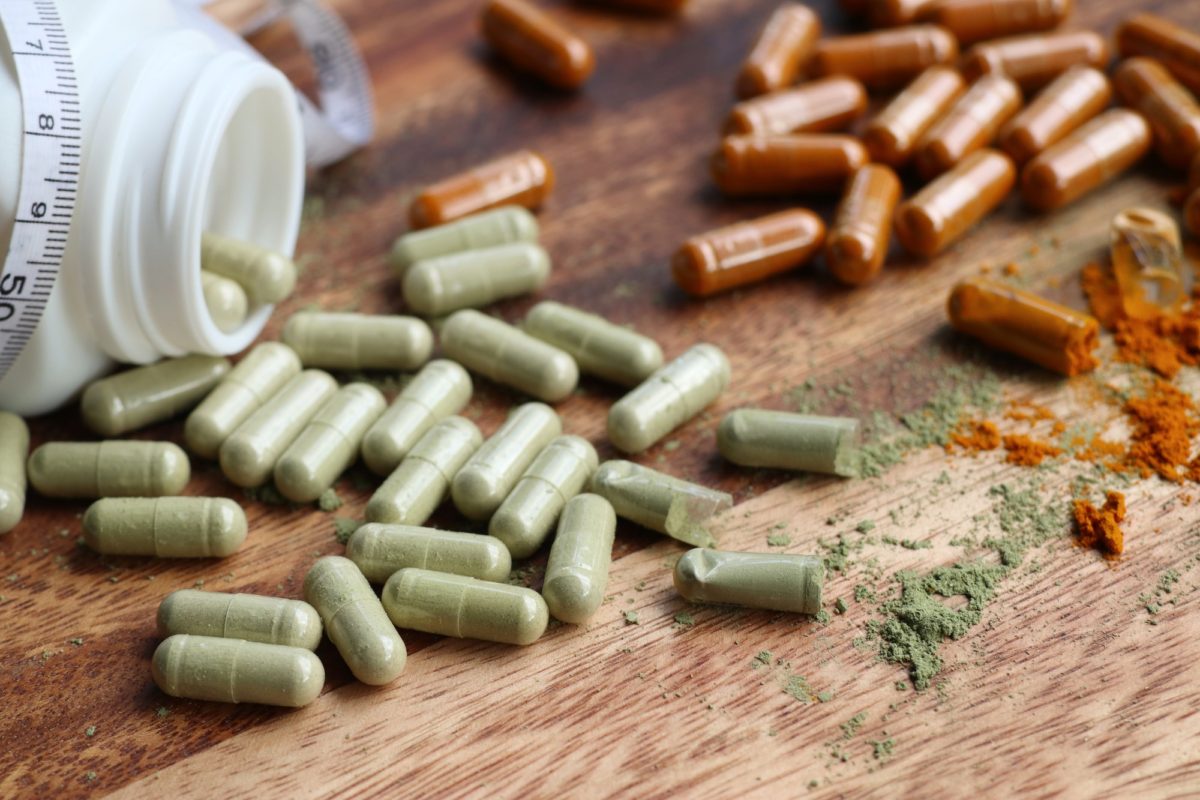
There is a beauty supplement, sold without a prescription at any pharmacy, that can make your thyroid test look like that of someone with severe hyperthyroidism. It's called biotin, and this problem has already led people to receive a wrong diagnosis and treatment they didn't need. It is the most striking case, but not the only one: a whole list of common medications affects the thyroid or the way it is measured — and almost no patient is warned about this before having blood drawn. In this article, every claim comes with the scientific reference behind it — the full list is at the end.
The distinction that makes sense of everything
Before the list, one distinction that completely changes what should be done.
Two different things are going on, and they are often confused:
Some substances truly change how your thyroid works. The gland actually starts functioning differently, and the test is right to show it.
Others affect only the measurement. Your thyroid is perfectly fine; it's the laboratory machine that gets confused.
The management of each case is the opposite of the other. In the first, the patient is monitored and sometimes treated. In the second, all it takes is stopping the substance and repeating the test — treating would mean creating a disease that didn't exist.
That is the difference between biotin and everything else on the list. It's worth understanding before anything else.
Biotin: it fools the lab, not your body
Biotin is sold as a supplement for hair, skin, and nails, and it shows up in almost every beauty formula. At the doses used for this purpose, and especially at high doses, it interferes with the method many laboratories use to measure hormones.
The result follows a characteristic pattern: TSH comes back falsely low and thyroid hormones come back falsely high — exactly the picture of hyperthyroidism. In some cases, even the antibody typical of Graves' disease comes back positive in a person who doesn't have the disease.
This is not a hypothesis. There are published reports of patients who were diagnosed with Graves' disease because of biotin, with test results that returned to normal as soon as the supplement was stopped (Barbesino, Thyroid, 2016; Elston et al., Journal of Clinical Endocrinology & Metabolism, 2016). The phenomenon has been studied in detail, including laboratory methods to get around it (Piketty et al., Clinical Chemistry and Laboratory Medicine, 2017).
Your thyroid is fine. It's the test that is wrong.
Imagine what this means in practice: a person takes a formula to strengthen their hair, has a routine blood test, is diagnosed with hyperthyroidism, starts medication to slow the gland down — and ends up with real hypothyroidism, caused by the treatment.
What to do
Recommendations on how long to stop vary with the dose, ranging from two to several days before the blood draw. The higher the dose, the longer the interval needed.
When in doubt, do two simple things: tell the laboratory that you take biotin — they know whether the method they use is subject to interference — and tell your doctor before accepting any new thyroid diagnosis.
The medications that truly affect the gland
Here the change is real, and the test is right.
Amiodarone. It is an important medication for heart arrhythmias and is extremely rich in iodine. It can cause both hypothyroidism and hyperthyroidism, and the condition it triggers comes in different forms, with different treatments (Bogazzi et al., Journal of Clinical Endocrinology & Metabolism, 2010). Anyone taking it needs thyroid monitoring — and that isn't always arranged.
Lithium. Used in bipolar disorder, it interferes with the gland's release of hormone and is a recognized cause of hypothyroidism and goiter (Lazarus, Best Practice & Research Clinical Endocrinology & Metabolism, 2009). This is not a reason to abandon lithium — it is a reason to monitor.
Cancer immunotherapy. This is the newest and an increasingly common cause. Drugs that stimulate the immune system to attack the tumor can also lead it to attack the thyroid. A systematic review showed that thyroid dysfunction is among the most common endocrine side effects of this type of treatment (Barroso-Sousa et al., JAMA Oncology, 2018).
Estrogen. Hormone replacement therapy and birth control pills increase a protein that carries thyroid hormone in the blood — and, as a result, increase the levothyroxine requirement in people who are already being treated. This was demonstrated in a study published in the New England Journal of Medicine (Arafah, 2001). Starting or stopping estrogen is a reason to reassess the dose.
Corticosteroids at high doses can temporarily lower TSH, which confuses the interpretation of a test done during that period.
A broad review of the full range of medications that affect the thyroid, also published in the New England Journal of Medicine, brings this overview together (Burch, 2019).
The honest counterweight: don't stop any medication because of this article
This needs to be spelled out clearly.
Nothing in this article is a reason to stop a medication on your own.
Amiodarone treats arrhythmias that can be fatal. Lithium prevents severe episodes in bipolar disorder. Immunotherapy treats cancer. In all these cases, the benefit of treatment usually far outweighs the thyroid problem — which can be monitored and treated.
The goal here is different: that you know you need to be monitored, and that your doctor knows what you are taking before interpreting a test.
The only thing this article suggests stopping temporarily is biotin, which is a supplement — and even then only before the blood draw, not forever.
The practical mistake that ruins everything
If you take away just one thing from this article, let it be this:
Mention your supplements at your appointment. They count.
The line I hear most often is "oh, that's just something natural, it's not a medication." Hair-and-nail formulas, beauty complexes, multivitamins, collagen with vitamins — any of them can contain enough biotin to throw off the test.
The list to bring before any thyroid test
- All your supplements, with the labels if possible — especially those for hair, skin, and nails.
- All medications you take regularly, including those prescribed by other doctors.
- Anything you recently started or stopped — birth control pills and hormone replacement therapy belong here.
- Cancer treatments, current or recent.
- Contrast agents from imaging tests done in the last few months, which contain iodine.
- The time you take your levothyroxine and what you eat or drink close to it.
And one question worth asking when a result is unexpected: could any of my medications or supplements have altered this test? Sometimes it prevents an entire diagnosis.
The bottom line
A thyroid test is not interpreted in a vacuum. The same result means different things depending on what the person is taking — and, in the case of biotin, it may mean nothing more than a beauty supplement in the bathroom cabinet.
Before accepting a new thyroid diagnosis, ask the cheapest question in medicine: what am I taking?
If your test came back abnormal and surprised everyone, including you, take that inventory before starting any treatment. The answer may be in a bottle you never even considered a medication.
Scientific references
- Burch HB. Drug effects on the thyroid. New England Journal of Medicine. 2019;381(8):749-761. PMID: 31433922.
- Barbesino G. Misdiagnosis of Graves' disease with apparent severe hyperthyroidism in a patient taking biotin megadoses. Thyroid. 2016;26(6):860-863. PMID: 27043844.
- Elston MS, Sehgal S, Du Toit S, Yarndley T, Conaglen JV. Factitious Graves' disease due to biotin immunoassay interference: a case and review of the literature. Journal of Clinical Endocrinology & Metabolism. 2016;101(9):3251-3255. PMID: 27362288.
- Piketty ML, Prie D, Sedel F, et al. High-dose biotin therapy leading to false biochemical endocrine profiles: validation of a simple method to overcome biotin interference. Clinical Chemistry and Laboratory Medicine. 2017;55(6):817-825. PMID: 28222020.
- Bogazzi F, Bartalena L, Martino E. Approach to the patient with amiodarone-induced thyrotoxicosis. Journal of Clinical Endocrinology & Metabolism. 2010;95(6):2529-2535. PMID: 20525904.
- Lazarus JH. Lithium and thyroid. Best Practice & Research Clinical Endocrinology & Metabolism. 2009;23(6):723-733. PMID: 19942149.
- Barroso-Sousa R, Barry WT, Garrido-Castro AC, et al. Incidence of endocrine dysfunction following the use of different immune checkpoint inhibitor regimens: a systematic review and meta-analysis. JAMA Oncology. 2018;4(2):173-182. PMID: 28973656.
- Arafah BM. Increased need for thyroxine in women with hypothyroidism during estrogen therapy. New England Journal of Medicine. 2001;344(23):1743-1749. PMID: 11396440.
📖 Want to go deeper? My book HASHIMOTO'S covers the protocols and foundations of the functional approach to hypothyroidism and Hashimoto's: available on Amazon.
📅 Personalized consultation (in person in Campinas, São Paulo, Brazil, or via teleconsultation): WhatsApp +55 11 99385-1224
📱 Follow on Instagram: @drandre.azevedo