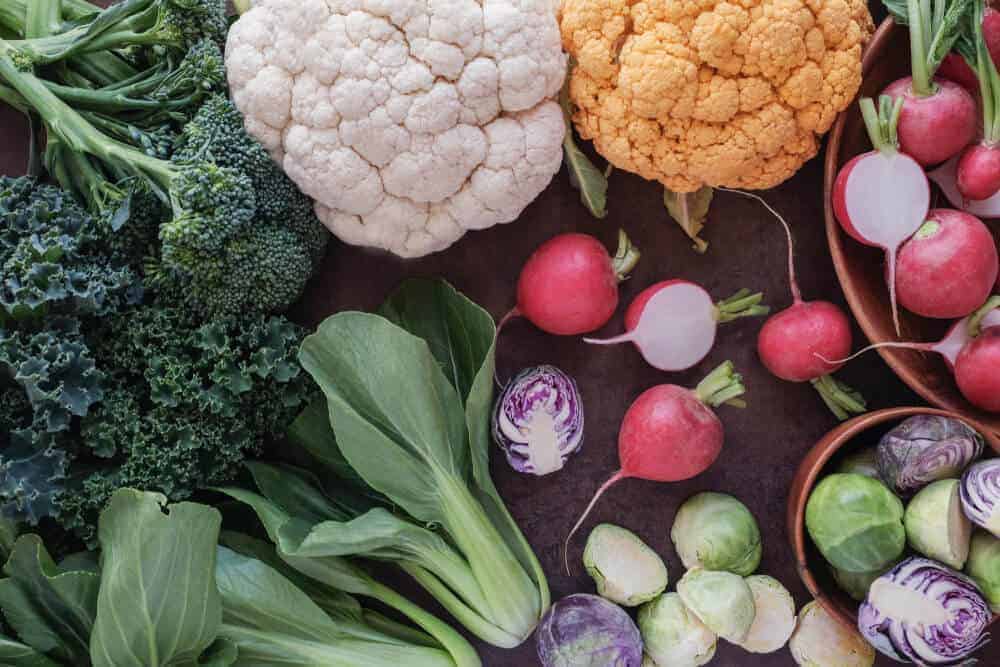
Broccoli, collard greens, cabbage, and soy show up on the forbidden-foods list of practically every online Hashimoto's protocol. Many people cut these foods out for years, afraid they are feeding the disease. The evidence tells a far calmer story than the fear suggests — but there are two legitimate caveats that nobody explains properly, and they aren't the ones you're thinking of. In this article, every claim comes with the scientific reference behind it — the full list is at the end.
Where the accusation comes from
The accusation isn't made up. It has a real chemical basis, and it's worth understanding so you know where it applies.
Vegetables in the broccoli family — the same family as cabbage, collard greens, cauliflower, and arugula — contain compounds that, in the lab, can interfere with the thyroid's uptake of iodine. Soy, on the other hand, contains substances that can disrupt an enzyme involved in producing thyroid hormone.
These substances exist, and they do what people say they do. The flaw in the reasoning is the next leap: what happens in a test tube, with a concentrated substance, is not what happens on your lunch plate.
What the real math shows
Here is the study that brings order to this topic.
Researchers did the calculation that was missing: they measured the concentrations of these compounds in people's plasma, compared them with the amounts present in the vegetables, and estimated the real risk of hypothyroidism from ordinary dietary intake (Felker et al., Nutrition Reviews, 2016).
The conclusion is reassuring for anyone who eats real food. The amounts reached with normal vegetable consumption stay far below what would be needed to harm the thyroid. It would take extravagant, sustained consumption to come anywhere near the risk range.
Eating broccoli at lunch is not a risk factor for your thyroid.
One practical detail is worth adding: cooking reduces these compounds. The cooking water carries part of them away, and heat inactivates the enzyme that activates them. Cooked vegetables, which is how most people eat them, are even less of a concern than raw ones.
What about soy?
Soy has been studied more directly, and here there is a meta-analysis — the type of study that pools several studies to see the overall picture.
The result: soy did not produce a clinically relevant change in thyroid hormones in adults. There was a slight effect on TSH in some analyses, with no clear practical impact (Otun et al., Scientific Reports, 2019).
This confirms an earlier review devoted to the subject, which had already concluded that soy does not cause hypothyroidism in people with a healthy thyroid and adequate iodine intake (Messina and Redmond, Thyroid, 2006).
For most people, soy in the diet is not a thyroid problem.
The three caveats that actually matter
Now for the exceptions — and notice that none of them is "don't eat broccoli."
1. When iodine is lacking
This is the central point, and the most overlooked one. The effect of goitrogens depends on how much iodine is available: they matter mainly in people who are already deficient. In iodine-deficient populations, these compounds contribute to goiter; where iodine is adequate, the effect practically disappears (Delange, Thyroid, 1994; Zimmermann and Köhrle, Thyroid, 2002).
In Brazil, table salt is iodized by law, and classic deficiency is rare — the subject of the article on iodine here on the blog. In other words, the condition that would make goitrogens relevant is precisely the one most Brazilians don't have.
2. The timing of soy relative to your medication
This is the most practical caveat of all, and it's about timing, not prohibition.
Soy can interfere with the absorption of levothyroxine, just as calcium and iron do. There is a reported case of a patient who needed a higher dose of the medication after starting a soy protein supplement (Bell and Ovalle, Endocrine Practice, 2001).
The solution isn't to cut out soy — it's to respect the time gap, just as you do with the others. The article on levothyroxine on this blog walks through that routine in detail.
3. The warning sign in subclinical hypothyroidism
This is the caveat that makes me write this article carefully instead of simply giving everything the green light.
A randomized study gave a soy phytoestrogen supplement to people with subclinical hypothyroidism — that is, with a thyroid already at its limit — and observed increased progression to overt hypothyroidism compared with the control group (Sathyapalan et al., Journal of Clinical Endocrinology & Metabolism, 2011).
Note the difference: this was with a concentrated supplement, not food, and in people whose thyroid function was already abnormal. It is not the same as drinking soy milk with a normal thyroid.
A concentrated soy supplement in someone whose thyroid is already at its limit is a different conversation — and that one calls for caution.
There is also one specific situation worth noting because it is high-risk: babies with congenital hypothyroidism who are fed soy formula need extra attention, because the formula complicates management of their treatment (Conrad et al., Archives of Disease in Childhood, 2004). That is a matter for the pediatrician, and it can't be sorted out on the internet.
The honest counterweight: the cost of cutting them out
Here the counterweight points in the opposite direction from most articles in this series — and that is exactly why it needs to be said clearly.
Cutting cruciferous vegetables out of your diet out of fear has a cost, and no demonstrated benefit.
Broccoli, collard greens, and their relatives are sources of fiber, vitamins, minerals, and compounds associated with good health outcomes. Replacing them with nothing, for years, to avoid an effect that practically doesn't occur at normal food amounts, is a bad trade.
And there is a cost that doesn't show up on any lab test: eating becomes a minefield. People start to fear their own plate, turn down invitations, treat food as a threat. For someone living with a chronic illness, that anxious relationship with food takes a toll — and it does nothing for the thyroid.
The practical mistake that ruins everything
If you take away just one thing from this article, let it be this:
The problem was never broccoli. If anything needs adjusting, it's the timing of soy relative to your medication.
What to do in practice
- Eat your vegetables, including those in the broccoli family, preferably cooked — which is how most people already eat them.
- Keep iodized salt in your kitchen. It's what makes the whole goitrogen debate irrelevant for you.
- Separate soy from levothyroxine by a few hours, as you do with calcium and iron.
- Be wary of concentrated soy supplements if you have hypothyroidism, especially subclinical hypothyroidism — and talk it over before you start.
- Don't cut out entire food groups based on an internet list. If someone recommended cutting something out, ask what the evidence is and who it applies to.
The bottom line
The foods accused of attacking the thyroid do, in fact, contain substances capable of interfering with it. But that depends on the dose, on how the food is prepared, and above all on whether or not there is iodine deficiency — and real food, in normal portions, doesn't come close to the range of concern.
What deserves attention isn't the vegetable on your plate: it's the concentrated supplement and the timing of your medication.
If you cut broccoli and collard greens out of your life because of Hashimoto's, you can bring them back. And if someone tells you otherwise, it's worth asking for the reference — because on this subject, for ordinary dietary intake, there isn't one.
Scientific references
- Felker P, Bunch R, Leung AM. Concentrations of thiocyanate and goitrin in human plasma, their precursor concentrations in brassica vegetables, and associated potential risk for hypothyroidism. Nutrition Reviews. 2016;74(4):248-258. PMID: 26946249.
- Otun J, Sahebkar A, Östlundh L, Atkin SL, Sathyapalan T. Systematic review and meta-analysis on the effect of soy on thyroid function. Scientific Reports. 2019;9(1):3964. PMID: 30850697.
- Messina M, Redmond G. Effects of soy protein and soybean isoflavones on thyroid function in healthy adults and hypothyroid patients: a review of the relevant literature. Thyroid. 2006;16(3):249-258. PMID: 16571087.
- Sathyapalan T, Manuchehri AM, Thatcher NJ, et al. The effect of soy phytoestrogen supplementation on thyroid status and cardiovascular risk markers in patients with subclinical hypothyroidism: a randomized, double-blind, crossover study. Journal of Clinical Endocrinology & Metabolism. 2011;96(5):1442-1449. PMID: 21325465.
- Bell DS, Ovalle F. Use of soy protein supplement and resultant need for increased dose of levothyroxine. Endocrine Practice. 2001;7(3):193-194. PMID: 11421567.
- Conrad SC, Chiu H, Silverman BL. Soy formula complicates management of congenital hypothyroidism. Archives of Disease in Childhood. 2004;89(1):37-40. PMID: 14709499.
- Delange F. The disorders induced by iodine deficiency. Thyroid. 1994;4(1):107-128. PMID: 8054857.
- Zimmermann MB, Köhrle J. The impact of iron and selenium deficiencies on iodine and thyroid metabolism: biochemistry and relevance to public health. Thyroid. 2002;12(10):867-878. PMID: 12487769.
📖 Want to go deeper? My book HASHIMOTO'S covers the protocols and foundations of the functional approach to hypothyroidism and Hashimoto's: available on Amazon.
📅 Personalized consultation (in person in Campinas, São Paulo, Brazil, or via teleconsultation): WhatsApp +55 11 99385-1224
📱 Follow on Instagram: @drandre.azevedo